Reducing Risk Weightage: What’s in it for the NRI?
Earlier this month, the RBI had reduced the risk weightage on home loans upto Rs. 20 lakh from 75% to 50%. This move left the average investor wondering how this would work for him.
There was, on the one hand, the RBI upping the interest rate on home loans. On the other, NRIs felt further squeezed when the RBI restrained banks from extending loans over Rs. 20 lakh against their NRE and FCNR deposits.
NRI investment in real estate took a minor dip as interest rates on NRE and FCNR deposits were also tweaked in April this year. NRI deposits reflected an outflow of USD138 million in February, as against a constant inflow in January, though the figure for NRI deposits for February to April was still higher than the previous year by USD1.4 billion.
With real estate in India maintaining a healthy performance in spite of the checks imposed by the RBI, NRIs are eager to make investments in lucrative property projects in the country.
This is where the RBI’s announcement on reducing the risk weightage comes in handy for the NRI investor. So, what is risk weightage and how does it make it easier for an NRI to invest in Indian real estate?
RBI norms demand a reserve capital of Rs.9 for every Rs.100 that banks give out as loan. The risk weightage on home loans was fixed at 75%, which means a minimum capital of Rs. 6.75 was to be maintained by the bank for every Rs. 100 that it lent.
Now, with the reduction in risk weightage to 50%, banks need to maintain just Rs. 4.50 as capital for every Rs. 100 that it lends.
This translates into a lower capital requirement for banks, enabling it to transfer the benefit to the borrower. Banks are now considering a revision of their interest rates, and Union Bank has initiated this w.e.f.7th May, by reducing interest rates by 50 basis points on loans upto Rs. 20 lakh.
A Rs. 20 lakh loan fits neatly into the budget of a Tier II and Tier III city project. These cities are the focus of attention of real estate analysts, international investors, property managers and real estate developers operating in India.
Tier II and III cities in India are offering the best of both worlds today, as sophisticated apartments, health and entertainment centres, shopping malls and luxury and budget hotels take centre stage. NRIs are increasingly opting for properties in these locations where comforts do not necessarily come at a price.
The chart below offers an easy reference for selecting the most promising locations for investment:
| Location | Location | Area (sq ft) | Bedrooms | Price (Rs lakh) |
| Ahmedabad | Ambawadi | 1,500 | 3 | 22.5 |
| Ahmedabad | Bopal | 1,500 | 3 | 18 |
| Ahmedabad | Gurukul | 1,500 | 3 | 21 |
| Ahmedabad | New CG Road | 1,000 | 2 | 16 |
| Ahmedabad | Vastrapur | 1,500 | 3 | 19.5 |
| Bangalore | Whitefield | 767 | 2 | 23.01 |
| Faridabad | Sector 78 | 1,050 | 2 | 17.32 |
| Jaipur | Ajmer Road | 1,050 | 2 | 22.4 |
| NCR | Bhiwadi | 1,150 | 2 | 16.67 |
| NCR | Sonipat | 1,500 | 3 | 23.25 |
| Pune | Hadapsar | 873 | 2 | 15.71 |
| Pune | Kathe Wasti | 970 | 2 | 21.34 |
| Pune | Pimple Saudagar | 618 | 1 | 16.68 |
| Pune | Pimple Saudagar | 910 | 2 | 21.84 |
| Zirakpur | Chandigarh Ambala Road | 1,080 | 2 | 17.3 |
| Zirakpur | Green View Homes | 750 | 2 | 12 |
| Zirakpur | VIP Road | 1,552 | 3 | 21.8 |
| Prices subject to change. Source: Knight Frank (India) |
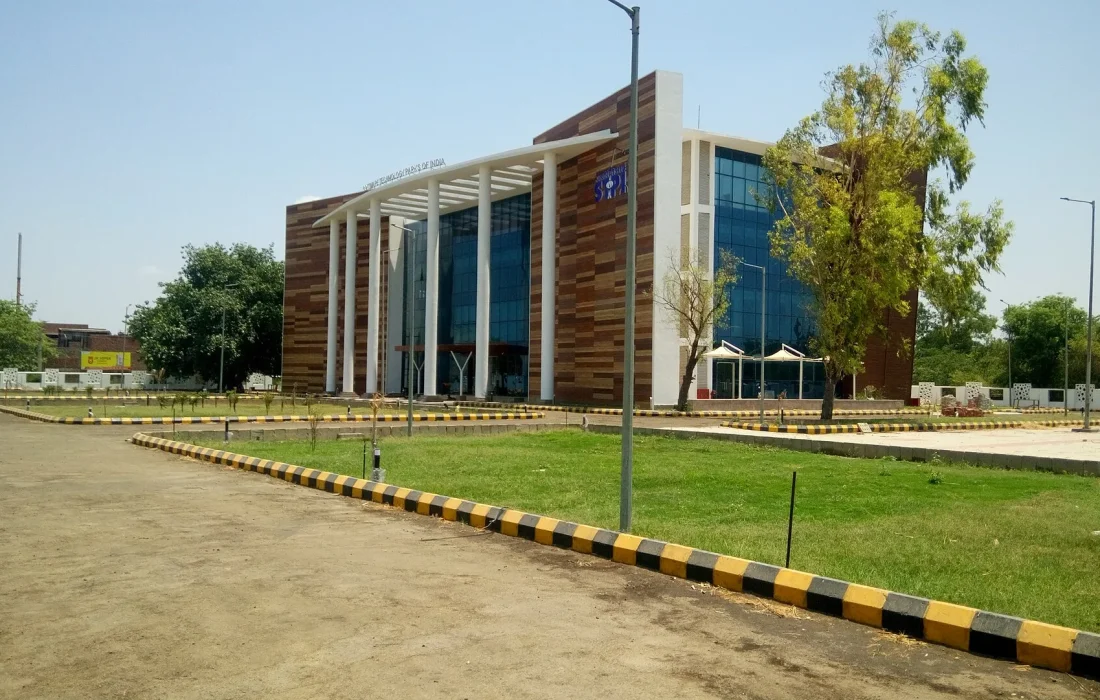
Photo: Bagmane Tech Park, Bangalore (2024) 161 by Gpkp, licensed under CC BY-SA 4.0, via Wikimedia Commons.