2007: A Heady Start for Indian Hospitality
The first half of 2007 has seen several realty companies venturing into the hospitality business, and a number of joint ventures with foreign brands have been announced to fill the yawning gap in the sector.
Research reports from KPMG have brought to light the potential that exists for the hotel business in India, where just 40,000 rooms presently cater to an average of 430 million tourists a year.
While large hoteliers like Marriott, ITC and the Indian Hotels Company
have announced their plans to augment room capacity through luxury projects
in metros and Tier II cities, it is the budget hotel segment which has
really caught the attention of investors.
Budget hotels
Eager to cash in on the vast market for economy hotels, foreign brands have chalked out comprehensive projects with big budgets in association with Indian real estate developers. Emaar MGF engaged Premier Travel Inn in June to add 12,000 rooms through 80 budget hotels in India within a decade, while Istithmar Hotels announced 8 innovative budget easyHotels for Mumbai, Chennai, New Delhi and Kolkata in the short-term. Bangalore and other locations would be covered in their second phase, covering
eight more hotels by 2009.
Domestic operator Sarovar Hotels with its 3 hotel chains – deluxe Sarovar
Premiere, the 3-star Sarovar Portico and the Hometel service hotel, is stepping
in with pocket-friendly hotel packages too for the business traveller, and
has plans to add 20 more hotels to its existing properties by 2009.
Into its fourth year, Roots Corporation, a subsidiary of Indian Hotels,
is gearing up to meet its target of 8 hotels by March 2008. By 2010,
Ginger hotels, the brand under which the budget range operates, will manage
50 such properties.
Pricing Strategy
Ginger’s competitive pricing at an all-inclusive Rs.999 for a single room
and Rs.1, 799 for a double throughout the year has found favour with the
budget traveller. On the other hand, Krizm Hotels follow a flexible pricing
model in their existing Red Fox chain of hotels in Hyderabad, Delhi and
Jaipur.
Ginger chooses to locate its budget hotels in cities and towns which
have a consistent flow of business traffic like Tirupur, Durgapur
and Nasik. Roots has also ventured into operating the accommodation facilities
of public sector enterprises, starting with the Rail Yatri Nivas in New
Delhi.
Essentially Innovative…
The no-frills Ginger hotels offer “smart basics” like a flat TV and internet connection, an ATM and a gym, and make up for the lack of room service by facilitating dial-in services from local eateries. The young, thrifty traveller, in turn, is also spared the extra costs on tips to the hotel staff.
The easyHotels from Istithmar have adopted a novel “stack, connect and stick” model of construction for their properties. The facilities include a well-sprung bed, a shower unit, a work station, and an ‘activity’ wall that includes a flat screen TV and internet connection. The self-contained units would be pre-fabricated at the manufacturer’s
site and delivered fully assembled with all internal fixtures.
Budget hoteliers are latching on to the latest concept of locating
within the mall premises to save on real estate costs, as well as their
expenses on food and beverages, which do not contribute sufficiently to
their profits.. The arrangement works to the advantage of mall owners as
well, who are assured of a steady footfall.
Luxury hotels
Of the 78 ongoing hotel projects in India which will add 35,000 rooms in
all categories of hotels in India, 28% belong to the deluxe category. With
an eye on the future market, the big banners are committed to major investments
in the 4, 5 and 7 star class.
Leela Hotels is adding to its chain with new hotels in Delhi, Udaipur,
Chennai, Hyderabad and Pune by 2009 at an investment of USD 270
million, while ITC is entering into a franchise agreement with Starwood
Hotels and Resorts. Apart from the seven star hotel projects planned for
Kolkata and Ahmedabad, the country’s largest luxury hotel would also be set up by the company in Chennai
Charting a different route, IHHR Hospitality is expanding with three more of their “Ananda-In the Himalayas” retreats at a cost of Rs.1, 360 crore. In addition, their “Ista” brand of business hotels in Ahmedabad, Amritsar, Pune, are already under construction, while Nagpur and Coimbatore would take off by early 2008. The company’s Chandigarh project is scheduled to start in September 2008.
Hoteliers have been quick to spot growing business centres, and major hotel corporations are concentrating on emerging cities like Gurgaon, where Indian Hotels is partnering HB Estate Developers for a 200-room Taj business hotel. Following a similar trend is the Oberoi group with a lavish budget of Rs.6
billion on luxury hotels in Goa and Rajgarh in Madhya Pradesh, apart from
its new project in Mumbai.
Joining the bandwagon is Sarovar Hotels, holding the franchise
for Carlson Hospitality Worldwide, and owning the Park Inn and Park Plaza
hotels. The group is venturing into new territories like Shillong and Tezpur
apart from projects in Chennai, Bangalore, Ludhiana and Gurgaon.
Leading real estate developer DLF has forged ties with Hilton to
develop 10 hotel sites in Delhi, Mysore, Kolkata, Bangalore, Bhubaneshwar,
Hyderabad and Goa, with the ultimate target of 50-75 hotels over
the next 5-7 years
Debutants to the industry, the D S Group, are working on a multi-pronged
strategy with a string of hotel projects in every vertical. Over
the next 5 to 7 years, the company will develop a destination complex
with a 5 star facility for 250 rooms, and a 100 room budget hotel in Kolkata
and Jaipur. It is working in partnership with the state government
for a 200 room 5-star project in Guwahati. Noida, Greater Noida, Gurgaon,
Udaipur, Simla, Bhubaneswar and the Jim Corbett National Park also
figure in the group’s
plans.
The surge of investment in hospitality has led to a debate on their
viability, and questions are being raised on their future. At the Hotelex
Conclave on July 20 where the organizers of the upcoming Hotelex India 2007
met, participants were confident of sustained growth, though agreed that
challenges need to be met with strategies to retain the upcoming sector.
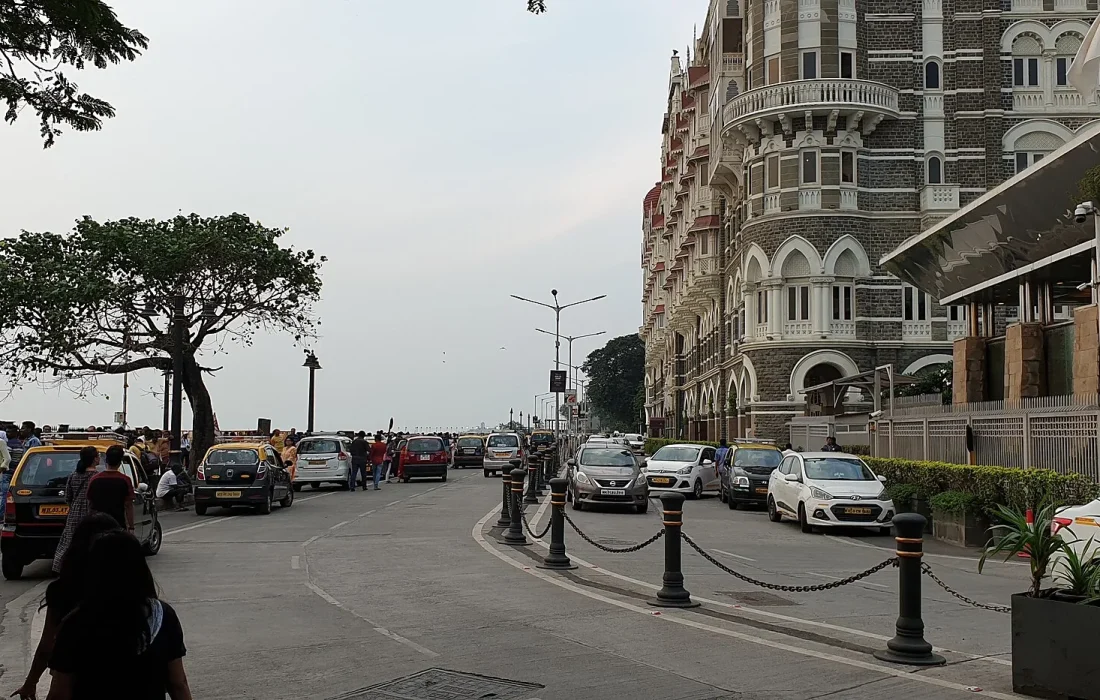
Photo: Luxury hotel near Gateway of India by Shadab Ali, licensed under CC BY-SA 4.0, via Wikimedia Commons.