What do NRIs look for in terms of projects – what kind of projects in terms of real estate can they look forward to and not just NRIs but PIOs, Foreigners? Ans: I would like to clarify in the beginning that what has been done recently in March is permitting FDI with instruction development sector. It is not in the real estate sector per se. In the sense can’t buy real estate and just sell it. You have to develop it, construct upon it or at least put in the minimum development and then you can sell it. So this is what has been permitted in March last year and NRIs. PIOs and all foreigners can look forward to equal treatment with their Indian counterparts in this sector. They can invest in land, buy it, construct upon it or just develop it, sell constructed buildings or just sell developed plots, which they weren’t allowed to do earlier. But the new policy is different from the old one in more ways than one. Earlier on, all this had to come with prior government approval and now for all construction development projects; we can welcome FDI without government approval. It is called the automatic route. Besides initially it was restricted only to the housing sector and now it has opened up. It is townships, housing, commercial area, and infrastructure development whatever. It also includes recently developed plots. Thirdly there were certain restrictions in terms of minimum area of land, minimum number of units etc but now all this has been set aside and we only designate it in terms of minimum constructed area – 50,000 sq .mts of construction is has to take place if you go in for a construction project and depending upon your FSI you can decide the plot size and that is not important and on other hand if you go in for the developed land and you are selling developed land it is 25 acres. Q2). What exactly is the automatic route?
Ans: Now one doesn’t have to go to the Reserve
bank and do the paper work. There is also no need to go to Foreign
Investment paper board, which was the case earlier and that
gives more confidence. The paper work has eased and given the
clients confidence for investing in India.
Q3). What should an overseas investor look at while studying
the Indian real estate market depending on the kind of project
they have in mind and how should one go about considering the
notion that Indian real estate market lacks a lot of transparency?
Ans: There is certainly lack of transparency
although it is improving now. So any NRI trying to look at the
market should first look at which segment he wants to get into
like residential, retail or office base. They should consult
legal firms, real estate firms and study the market. Several
times in the past, when they took advice from relatives and
friends they burnt their fingers. While the real estate market
is booming at present one still needs to be cautious and go
for professional advice. Besides it should be for long-term,
which is important.
Q4). In your capacity as a consultant – what advice can
you give for people on how they can get all the clearances and
how should they go about it and whom to meet in the process?
Ans: It depends on the segment they want to
invest in. If one is going for office market investment then
they should first get in touch with consultants for advice on
the city they should go into. Before all this they should be
clear about their objectives, the size of investments and the
returns they are looking at.Based on several parameters the yield should be anywhere from
8-8.5% to 12% for office while in residential the returns would
be from 4 to 6%. So it all depends whether the land is for investment
or to develop. And in that case it is a completely different ball
game where they have to see the local demand-supply situation.
At the end of the day they have to know what the micro market
offers – what is the future and if one is looking at investment
then what are the utilities available. Like in India one has to
very cautious about the infrastructure such as the power situation,
connectivity, security facility and the future plans in the long-term.
All these aspects are important.
Q5). With your experience with clients how easily can
people get a one window clearance?
Ans: In cities like Delhi there are multi agencies.
Many authorities do create a problem but in certain states the
old laws still continue to hold good because real estate is
a state subject and the Central government can’t do much. But
few positive steps have been taken; like property tax used to
be a big issue, the stamp duties used to be high. In some states
they have turned into Unit Area method of taxation. Stamp duties
in some places have come down and they need to come down further.
Overall for the approval process there are still hurdles for
eg if you put up a hotel in India you need 40 permissions etc.Single window sometimes in a real estate project may be difficult
because there are several authorities. For instance when you are
constructing a building if it’s a multi-storied building then
firstly there would be town planning people from whom you would
need to get clearance on the design and then lifts, fire fighting
agencies etc. One cannot wish away those authorities but things
can be made more transparent and simpler.
Q6). How can we make this whole process more transparent
for a foreign investor?
Ans: As pressure builds up, awareness increases
and it is not as though nothing is happening but things need
to happen faster and I think they will but I think it is all
a part of administrative reform. Of course nothing can happen
overnight.
Q7). How are the sanctioning authority and monitoring
authority different?
Ans: In most states it is the municipal authority
that is the ultimate monitoring authority. So in some smaller
states or in non-urban areas; it is sometimes the town & country
planning but in urban areas where we expect most of the construction
to take place it is the municipal authority and ultimately it
is this authority that asks you to get clearances from electricity,
water supply etc and they are the ones who give you final permission
and sanction your drawings and plans hence they are the ones
who will monitor all.
Q8). How serious is the black money payment problem?
Most of us have no idea how to tackle it and we may lose our
hard earned money. Is there a way out?
Ans: Indian real estate and construction industry
has long suffered due to high incidents of black money transactions.
High stamp duties and complicated transfer policies and investor
laws and lack of transparency in the transactions were promoting
large-scale tax evasion. Buyers and sellers prefer to pay black
money or unaccounted money to seal the deal rather than pay
the high taxes.But with reforms coming in the income tax laws things have started
looking up though; lowering of stamp duty and property tax in
some states have also led to cutting down the menace of black
money as the State gears up in anticipation of large-scale investments.
Q9). In case of NRIs and foreigners, their money comes
in as white money. So is this going to affect FDI in any way-
this black money problem?
Ans: The black money component has reduced
tremendously in the last ten years and with reforms in property
laws, property taxation and stamp duty, things will simply improve
further. I don’t really think it is such an issue at all today.
And somebody who has only white money and wishes to invest through
cheque payment, I don’t think will face any problems whatsoever.
Q10). As per the new FDI norms the minimum investment
has to be USD 5 million for 51% shareholding. Now does this
involve funding of subsidiaries as well?
Ans: If you have a wholly owned subsidiary
by a foreign company then the minimum capitalization norm is
USD 10 million and if you have a joint venture; whether it is
74:26 or 51:49 that is immaterial. If one has a joint venture
then minimum capitalization is USD 5 million in foreign exchange.
India real estate and construction industry has long suffered
due to high incidents of black money transactions. High stamp
duties and complicated transfer policies and investor laws and
lack of transparency in the transactions were promoting large-scale
tax evasion. Buyers and sellers prefer to pay black money or
unaccounted money to seal the deal rather than pay the high
taxes. But with reforms coming in, the income tax laws, things
have started looking up though; lowering of stamp duty and property
tax in some states have also led to cutting down the menace
of black money as the State gears up in anticipation of large-scale
investments.
Q11). Now does this involve funding of subsidiaries as
well?
Ans: If you have a wholly owned subsidiary
by a foreign company then the minimum capitalization norm is
USD 10 million and if you have a joint venture; whether it is
74:26 or 51:49 that is immaterial. If one has a joint venture
then minimum capitalization is USD 5 million in foreign exchange.
That’s all that has been said. And this money this USD 10 million
if it is wholly owned by a foreign entity or USD 5 million if
it is a joint venture for Indian company this minimum amount
of foreign exchange has to come in within six months of the
date of commencement of business. Earlier on it was required
to come in up front etc. Now you have been given six months
to bring that money into India, not necessarily utilize it but
to bring in India.
Q12). And how long do you have to actually finish actually
your construction development work?
Ans: Well you have very generous norms; five
years to finish at least finish 50% of your project from the
date of getting all your clearances which I think Infact you
should be completing your project within three years in the
normal course. But anyway it’s extremely generous really but
there is a norm simply to protect the customer. So you don’t
have fly by night people coming in and things like that.
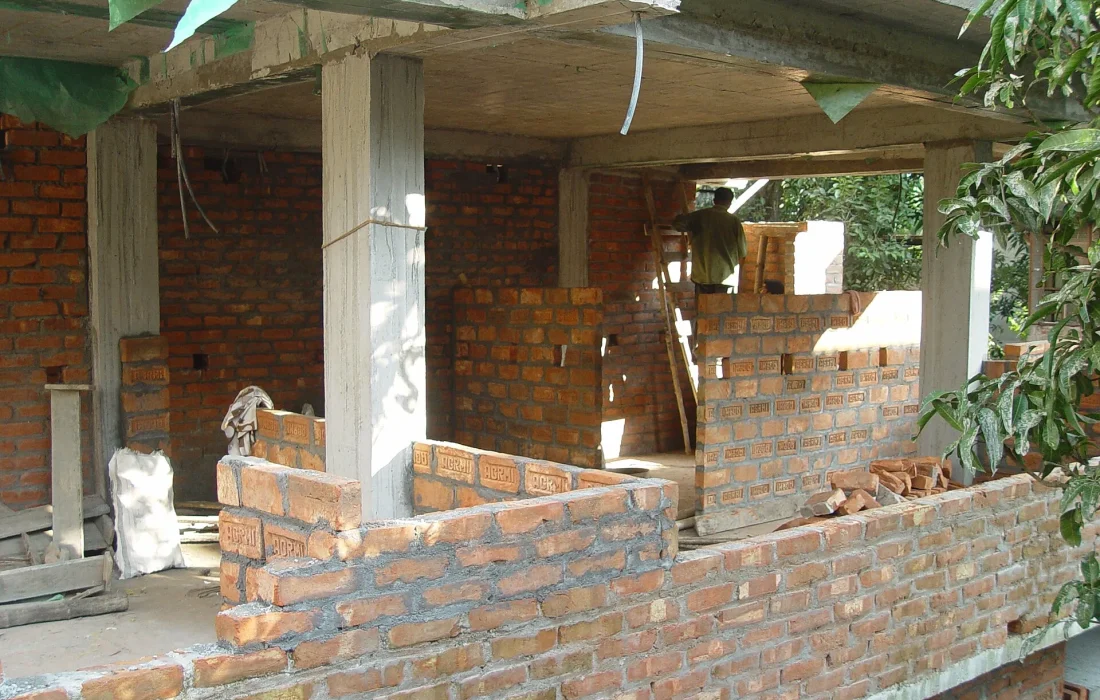
Photo: Low Cost Apartment In Making 02653 by Biswarup Ganguly, licensed under CC BY-SA 3.0, via Wikimedia Commons.