Judging Mutual Funds
An individual investor tracks the change in the net asset value
of a mutual fund over a period of time to assess its performance.
Experts however, believe that the degree of risk taken by the mutual
fund to achieve that return should also be factored in to ascertain
the fund’s success.
Evaluating the risk factor is integral while making an investment,
more so when picking up equity. Risk and returns run parallel, and
the fund manager’s main task is to strike equilibrium between the
two to maximize returns.
Mutual
funds need to be assessed on a risk adjusted basis
– this criterion for judging the performance of a mutual fund gives
an understanding of the risk a fund has taken to earn its returns.
A high risk adjusted return reflects a good performance. The Sharpe
ratio defines risk adjusted returns in a simple formula: the excess
of returns over a risk-free rate divided by the standard deviation
of returns over a stipulated time period.
A study of equity funds in India based on this formula, judged
on their performance after the stock market recovered in June, and
up to November 2006, showed Birla SunLife’s Frontline Equity
Fund as the front-runner. With absolute returns at 55%, its
risk adjusted returns are a notch higher at 57%. Its total assets
are Rs.115 crore, of which 88% was invested in equity. It selected
amongst others, Infosys and Mahindra and Mahindra when it was launched
in August 2002, and has added United Spirits, VSNL, Grasim, Sterlite,
IOB and UTI Bank recently to its portfolio.
The Service Industries Fund from ICICI Prudential also
shares a risk adjusted return of 57%, and an annual return of 61%.
96% of its 367.28 crore assets are invested in equities, a fraction
in debt, and the remaining in cash and current assets. Its portfolio
comprises Tech Mahindra, United Phosphorus, Container Corporation,
Infosys, Raymond, Siemens, CMC and ICICI Bank.
Reliance NRI Equity, a scheme exclusively
for NRIs also has a fair risk-adjusted return of 56% against an
actual return of 58%. 83% of its assets of Rs.1, 16.51 crore are
concentrated in equity and the remaining in cash. Infosys, Reliance,
HPCL, HLL, Tata Motors, Indian Overseas Bank, TCS and Suzlon comprise
its portfolio.
HDFC Growth Fund has a risk-adjusted fund of 55% and an annual
return of 56%.Its assets of Rs.359.56 crore are invested in equities
(97%), and the rest in reverse repo transactions. Divi’s Laboratories,
Infosys, SBI, BHEL, GE Shopping, Hanung Toys, Global Vectra and
Kansai Nerolac were selected by this fund for its portfolio.
The Rs.2, 035.55 crore India Special Situations Fund from Fidelity
did not fare well as per the risk-adjusted ratio of 53% , and 59%
annual returns during the period. It has invested heavily in equity
with ICICI Bank, SBI, Satyam Computers, Bajaj Auto and Dr Reddy’s
comprising a sizeable portion of its portfolio.
A below average performance came from JM Emerging Fund Leaders
with a risk adjusted ratio of 8%, and a return of only 15%. Its
assets total Rs.55.61 crore, and carry equity – cash instruments
ratio of 73: 27. It has picked fresh stocks from Apollo Tyres, GE
Shipping, India Cements and Mahindra & Mahindra.
With just Rs.12.2 crore assets, the Sahara Mid Cap earned 22% risk-adjusted
returns, against annual returns of 31%. Its portfolio comprises
Exide Industries, JHS Sevendgaard Laboratories, Accel Frontline,TCS,
Shree Digvijay Cement, Crompton Greaves, Aditya Birla Nuvo and Century
Textiles
Taurus Bonanza has a Rs. 50.68 crore with 95% invested in equity,
2% in debt,and 3% in money market instruments. Its low risk adjusted
return of 23%, and an actual return of 35% gave it a low rating.
The fund’s stocks include Crompton Greaves, Jaiprakash Associates,
BEML and Mahindra & Mahindra.
Principal’s Dividend Yield Fund has a high risk element, with 26%
annual and 24% risk-adjusted return. Its assets under management
are Rs.200.73 crore, and an 87% investment in stocks includes ONGC,
Cummins India, Tata Chemicals, Tamil Nadu Newsprint and Varun Shipping,
Jay Shree Tea and BPCL.
An assessment based on the risk-adjusted return is an objective
study of mutual funds, and helps investors in making choices for
their portfolio.
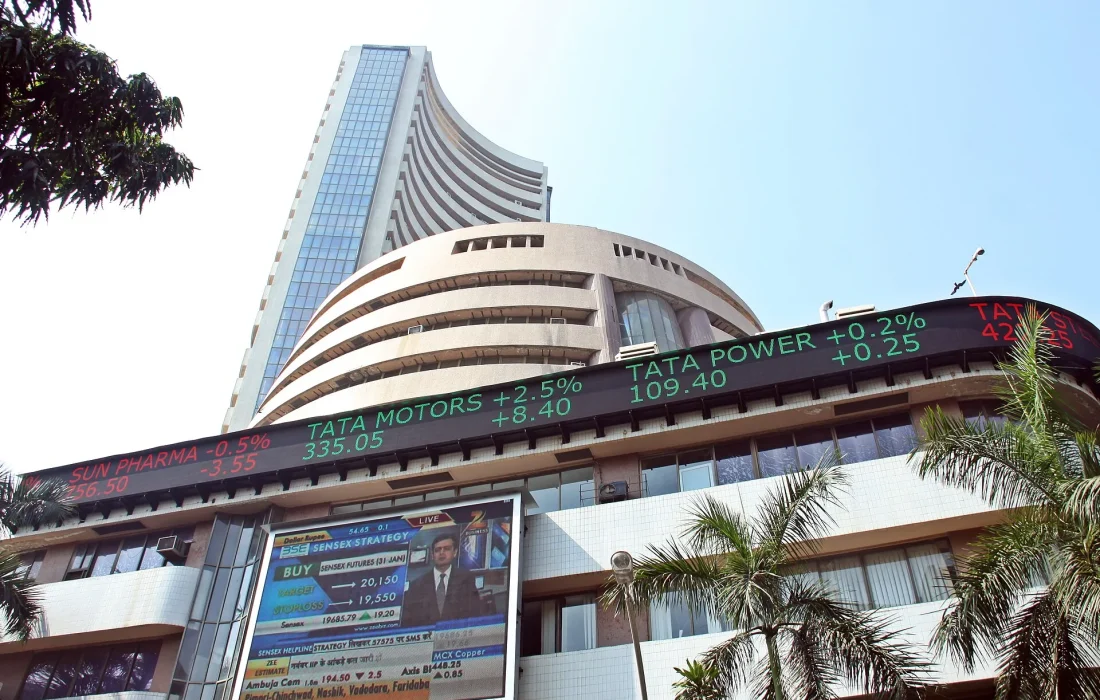
Photo: BSE building at Dalal Street by BSEINDIA, licensed under CC BY-SA 3.0, via Wikimedia Commons.